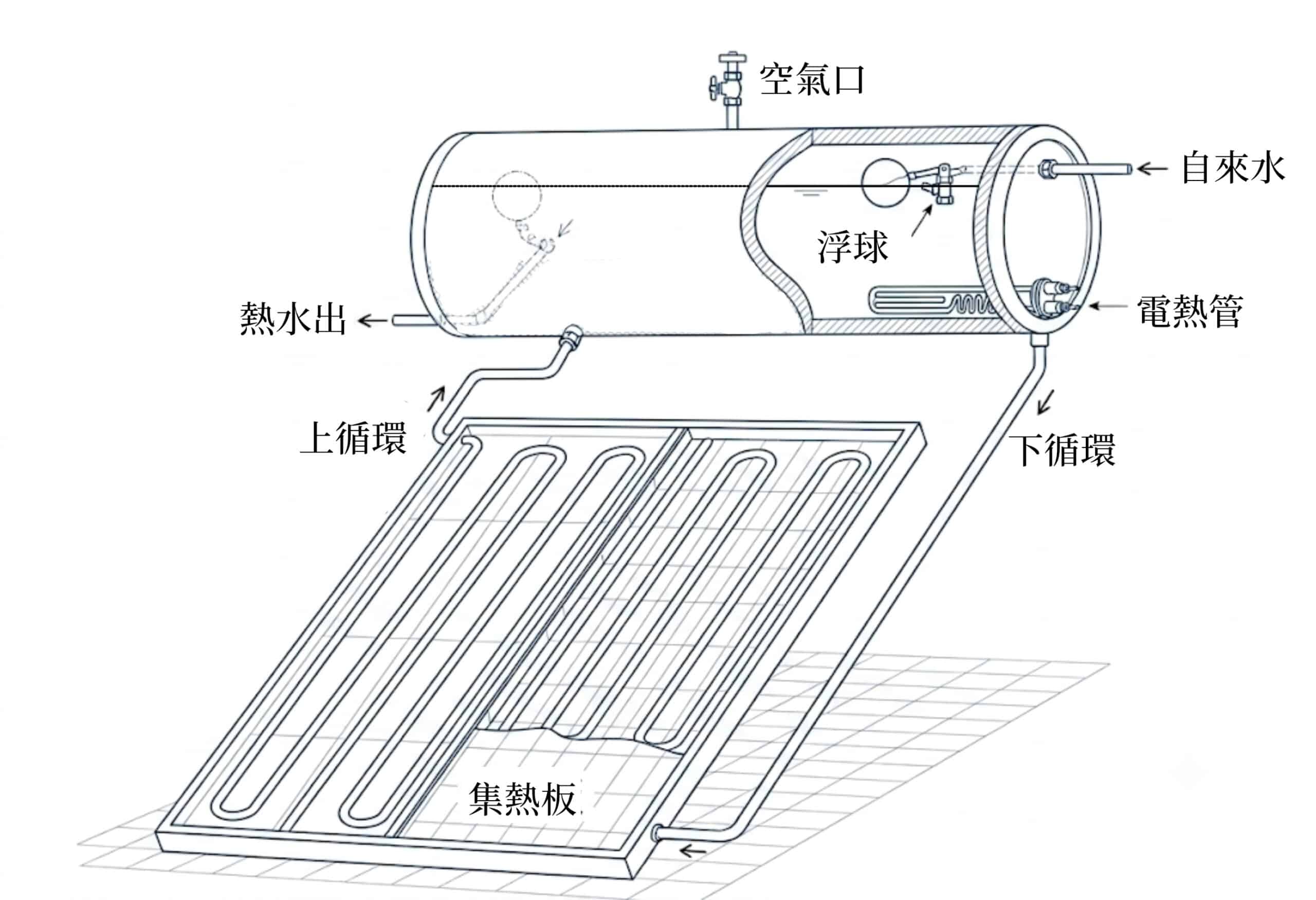


- From the very first day of use, traditional solar water heating systems develop limescale buildup inside the collector plates, hindering heat transfer and preventing solar energy from reaching the tap water. Over time, this scale buildup becomes increasingly noticeable, eventually preventing the solar panels from adequately heating the tap water in the tank. This problem only completely resolves itself and restores the system to its original condition after the collector plates have been cleaned.
- If the solar water heater is a privately installed residential appliance, and the owner knew at the time of installation that it needed to be cleaned regularly, the owner can clean it themselves or hire a plumber. It should be cleaned every 1-3 years. The heat transfer capacity will drop from 100% to about 20% and then return to 100%.
- For large-scale solar power systems in public buildings, the lack of a budget for regular cleaning and maintenance results in a decline in solar thermal efficiency. The system becomes reliant on electric heating elements or gas boilers for heating, and the solar panels gradually become clogged and unusable. However, the most expensive part of this system is the solar collector, making it a significant failure – a common perception among architects and electrical technicians. Users, having access to hot water, are often too lazy to address the problem. This leads to a massive waste of electricity or gas heating to provide enough hot water. A 300L system using auxiliary heating typically consumes more electricity than a 100L electric water heater (which can reheat water day and night), and is also much more expensive.
- If indirect heating is used, with a heat-conducting liquid (such as purified water or purified water with added glycerin) flowing inside the collector plate, and the heat-conducting liquid entering the coil heat exchanger inside the water tank to form a closed loop, preventing tap water from entering the collector plate, this problem is eliminated. This is the standard design method in Europe and America.
- When the cold water in the tank comes into contact with the hot coils, the temperature rises, and limescale forms on the surface of the coils. However, because the surface of the coils is enamel (glass), it is very smooth, making it difficult for limescale to adhere. Additionally, due to thermal expansion and contraction, the limescale settles to the bottom, so it's not a problem to clean it. If cleaning is needed, there are openings at the bottom of the tank, allowing for easy access and cleaning. Crucially, the heat collection efficiency of the collector plate does not decline, which is typical of a normal solar water heating system; auxiliary heating is only required on cloudy or rainy days.The heat collection effect will not decline.which is normal for a solar water heating system. Auxiliary heating is only needed on cloudy or rainy days.
Why must a vertical pressurized water tank be used? - Besides this fatal flaw, the second fatal flaw is that most of the failed systems in China are horizontal open systems. The most serious problem is that hot and cold water cannot be separated. The standard designs in Europe and America are vertical pressurized systems. Cold water enters from the bottom and pushes the hot water out from the top. Due to thermal expansion and contraction, the hot water automatically floats to the top. You can use up the last bit of hot water before needing to use auxiliary heating.
- In horizontal water tanks, hot and cold water cannot be separated, causing hot and cold water to mix and lower the overall temperature, necessitating auxiliary heating and wasting electricity. Vertical water tanks, on the other hand, have internal hot and cold water separation, often providing a small amount of hot water without the need for auxiliary heating.
The image above illustrates an example: in a horizontal water tank, heat is dispersed throughout the cold water, reaching only 30°C. With water entering through the float valve, hot and cold water mix, preventing the temperature from being concentrated. - The vertical water tank automatically separates hot and cold water internally. Cold water intake doesn't affect this separation; the top is always hot, so while the bottom remains below 30°C, the top is already at 45°C, sufficient to provide a small amount of hot water without needing to activate auxiliary heating and waste electricity. Even if auxiliary heating is necessary, only the top 1/5 of the water is heated. Horizontal water tanks, on the other hand, cannot heat only a small portion of the water, heating the entire tank until the water is completely hot, making it inefficient and wasteful, especially considering the sun won't be out the window the next day.
- On cloudy or rainy days, the water temperature may not be hot enough, but the hot water is concentrated at the top, which is still sufficient for a small number of people. If the hot water is insufficient, the top 1/5 is heated first, and then the main heating element in the middle 1/2 continues to heat, which is enough for most people. Finally, if needed, there is also a heating element at the bottom to heat the entire tank of water. If a vacuum tube solar collector is used, it will also provide some heating on cloudy or rainy days.
Why is it necessary to use a pressurized water tank? - In a pressurized water tank, the cold and hot water pipes have equal pressure, preventing sudden temperature fluctuations. Some dormitories or five-star hotels in China, in an effort to save money, use open-type water tanks, resulting in these fluctuating temperatures. This is very troublesome because the cold water pressure is from the tap, while the hot water pressure, dependent on a pump at the outlet of the open tank, is constantly changing. Some five-star hotels have had to modify their systems and replace the water tanks to solve the problem, indicating a design flaw. If hotel guests complain about fluctuating temperatures, the hotel cannot ignore it, but improving this is very difficult, requiring tank replacement and system modification, which is very expensive. This is another fatal flaw. (The image below shows a vertical pressurized coil water tank.)
The fatal flaw of solar water heating systems